


 Posts
Posts


This morning's meditation.
It is said:
sādhu-saṅge kṛṣṇa-nāma ei mātra cāi
saṁsāra jinite āra kono vastu nāi
"Other than sadhu-sanga and the name of Krishna, nothing else is needed to cross over the ocean of birth and death."
The holy name is not dependent on anything, even sadhana. It is effective at any time and any place. It is not that it will only act if chanted a certain number of times or at a certain time of the day.
Similarly, sadhana is not an absolute requirement in getting the mercy of sadhu-guru. Mahaprabhu blessed the animals in the Jarikhanda forest, and Narada Muni blessed the hunter Mrigari. What sadhana were they doing to justify getting such mercy?
What then is the necessity of having strict daily practices in our sadhana?
What we do affects our consciousness. Similarly, our consciousness makes our character. Therefore maintaining strict daily sadhana will build our character and thereby give us qualification for getting bhakti.
As Aristotle said: "We are what we repeatedly do. Excellence, then, is not an act, but a habit."
Sunday, September 16, 2007


Friday, September 14, 2007
Kirtana is Not for Our Prestige
 The following is a poem that we recently wrote for our Guru Maharaja's Vyasa-puja.
- - - - guru-bhakti on my sleeve
Proclaiming, “I’m sat-śiṣya”
- - - -But mere costumes don’t succeed
The sun will not be revealed
- - - -by the glow of my torchlight
Krishna’s chosen son, self-effulgent and so bright
- - - -Obvious without my self-appointed jihad
Our legs and the ground, sei mata sāra
- - - -Forever-blind boy, first glimpse of a star
Your pleasure is the ointment to see
- - - -deha prema-dhana. Yours, eternally
śríla gurudeva seva-prārthī,
Madhavananda Das and Krishna Kund Dasi
===================
Some devotees have asked us about the meaning of this poem.
kīrtana udeśya pratiṣṭhā nāhi
This title is in Oriya language: "kīrtana, or glorification is not for our prestige"
A circus of devotion
- - - - guru-bhakti on my sleeve
Proclaiming, “I’m sat-śiṣya”
Displaying one’s devotion for the sake of self-prestige is distasteful. Many persons speak about how rare it is to find a bona-fide guru and simultaneously often advertise themselves as the disciple of such a guru.
However, our Guru Maharaja used to say that it is more difficult to find a bona-fide disciple than it is to find a bona-fide guru. There is a Bengali saying: guru mile lakhe lakhe śiṣya mile eka -- "There are thousands and thousands of bona-fide gurus, but it is very difficult to find even one bona-fide disciple."
But mere costumes don't succeed
Just dressing up as a disciple won't give me success. Another meaning of succeed is "successor". With that meaning, we could say, "just posing or dressing as a disciple doesn't make one a successor or inheritor of the guru's transcendental wealth.
The sun will not be revealed
by the glow of my torchlight
Krishna's chosen son, self-effulgent and so bright
Sri Guru is revealed by Krishna, through the guru's own self-effulgence.
Obvious without my self-appointed jihad
Genuine service means acting according to the instructions of guru and Krishna without adding to or subtracting from them. Receiving such an instruction, one has adhikāra or qualification to act. Krishna says in Bg. 3.35:
śreyān sva-dharmo viguṇah para-dharmāt sv-anuṣṭhitāt
sva-dharme nidhanaṁ śreyah para-dharmo bhayāvahaḥ
It is far better to act according to the order we have received, even though faultily, than to do another's duties even if perfectly. Destruction in the course of performing one's own duty is better than engaging in another's duties, for to follow another's path is dangerous.
If we take it upon ourself to reveal the position of Krishna's representative (or try to coerce others into accepting what we see as his position) we are subtly saying that we are also on a very high platform. Such self-appointed "preaching" is like that of the Islamic fundamentalists who take to terrorism in the name of defeating the "heretics", and spreading their faith. They call this "jihad", today's common meaning of which is "holy war".
Our legs and the ground, sei mata sāra
In his article entitled, "Associates of Sri Chaitanya", (printed in the magazine, Sadhu-sanga the Birthplace of Bhakti) Srila Saraswati Thakur writes:
"The cognitive faculty of the individual soul can have no ground to stand upon unless the divinity Himself condescends to be the legs as well as the ground on which he is to stand to function at all. This function of the divinity is performed by the guru."
We have no cognitive ability to perceive Krishna or guru. We have no ability to do anything spiritual without the help of Krishna. Understanding this, Krishna comes in the form of Sri Guru, who is thus both our legs and the ground. How does Sri Guru provide this function? "sei mata sāra (Cc. ādi 12.10) -- his instructions are the essence of our spiritual life.
Forever-blind boy, first glimpse of a star
Our Guru Maharaja described how all the conditioned souls in this world are blind. He said that we are not the seers, the seer is Sri Guru and our position is to be the seen. He described how this blindness or conditioned nature has been there so long the date of its origin cannot be calculated. Without the mercy of Sri Guru that blindness will never go -- in that sense it is "forever".
He often told a story about a blind boy, who, based on his limited sense perception, thinks that there is no such thing as the sun (or that he can understand the sun with his senses). We are such eternally blind persons, proud and foolish, thinking that we understand the nature of the sun, even though we are blind. However, by the mercy of Sri Guru, even such a proud blind boy, can begin to get a glimpse of the sun (a star).
Your pleasure is the ointment to see
"The ointment to see" is ecstatic love: premāñjana-cchurita-bhakti-vilocanena santaḥ sadaiva hṛdayeṣu vilokayanti (Brahma-saṁhitā 5.38). Pleasing the guru through faithfully serving his instructions is the way to get that ointment.
deha prema-dhana. Yours, eternally
Sri Chaitanya Mahaprabhu prayed to Krishna, "deha prema-dhana -- please give me ecstatic love for you" (Cc. antya 20.37). Service to guru is everything. A sincere disciple's prayer is to get that service. The only payment we want for our efforts is kṛṣṇa-premā. If we obtain that prema (prema bhakti yāhā hoite, avidyā vināśa yāte) then our ignorance will go and we can truly say that we are eternally the servant of our guru (janme janme prabhu se).
śríla gurudeva seva-prārthī,
Desiring that service of Srila Gurudeva, this poem was composed.
Monday, August 28, 2006
Hide Your Guru
 Hide Your Guru
By Madhavananda Das
The following article was something that we wrote for issue number 16 of Sri Krishna Kathamrita Bindu.
In Hari-bhakti-vilasa, verse 2.147, Srila Sanatan Goswami quotes Sammohana-tantra:
gopayed devatam istam gopayed gurum atmanah
gopayec ca nijam mantram gopayen nija-malikam
One should hide one’s ista-deva, one should hide one’s guru, one should hide one’s mantra, and one should hide one’s japa-mala.
Wise persons keep their valuables in a confidential place. Similarly, an intelligent sadhaka does not advertise his or her guru, nor do they broadcast themselves as disciples of their guru. Considering themselves as low, fallen, and unfit to be considered disciples, sincere devotees do not want to advertise who their guru is.
Srila Krishnadas Kaviraj Goswami has illustrated the mood of a devotee and disciple:
jagai madhai haite muni se papistha
purisera kita haite muni se laghistha
I am more sinful than Jagai and Madhai and even lower than the worms in stool. (Cc. adi 5.205)
Similarly, Thakur Bhaktivinode has stated:
garhita acare, rahilama maji’,
na karinu sadhu-sanga
laye sadhu-vesa, ane upadesi,
e bada mayara ranga
Remaining absorbed in abominable activities, I never kept company with sadhus. Now I adopt the garb of a sadhu and act out the role of instructing others. This is maya’s big joke. (Saranagati 7.3)
Although Thakur Bhaktivinode had so much association with elevated vaisnavas, including his siksa-guru Jagannath Das Babaji Maharaja, he did not flaunt that. Rather, he considered that, na karinu sadhu-sanga — “I have never had association with sadhus”.
The essential principle in being a disciple is to follow the order of the guru. Srila Krishnadas Kaviraj Goswami has described:
acaryera mata yei, sei mata sara
tanra ajna langhi’ cale, sei ta’ asara
The order of the spiritual master is the active principle in spiritual life. Anyone who disobeys the order of the spiritual master immediately becomes useless. (Cc. adi 12.10)
Similarly, it is stated in the Raghu-vamsa:
sa susruvan matari bhargavena
pitur niyogat prahrtam dvisad-vat
pratyagrhid agraja-sasanam tad
ajna gurunam hy avicaraniya
Being ordered by his father, Parasuram killed his mother, Renuka, just as if she were an enemy. When Lakshman, the younger brother of Lord Ramachandra, heard of this, He immediately engaged Himself in the service of His elder brother and accepted His orders. The order of the spiritual master must be obeyed without consideration. (verse 14.46, quoted in Cc. madhya 10.145)
Srila Thakur Bhaktivinode has described that there are two types of disciples, the antarmukha-sisyas and the bahirmukha-sisyas. Antarmukha literally means “inward-facing”. It refers to someone who is introspective. Bahirmukha literally means “outward-facing”, and refers to someone who is absorbed in external things.
Antarmukha-sisyas are desirous of bringing pleasure to their guru. Their focus is on following the guru’s instructions. The antarmukha-sisyas practice gopayed gurum atmanah. They keep their guru and their relationship with him confidential. An antarmukha-sisya is not interested in advertising himself as a disciple of his guru, but prefers to follow the guru’s instructions. His meditation is to try to understand what will please his guru. The antarmukha-sisya is anartha-mukta-avastha, he is free from anarthas. His vision of guru is known as sevya-darsana. He sees that guru should be served and pleased.
Bahirmukha-sisyas are disciples who practice the opposite of gopayed gurum atmanah. They are absorbed in advertising their guru and in making a show of themselves as being big or intimate disciples. Such a disciple is also known as guru-giri, or one who makes a business out of guru and one’s relationship with guru. They are not absorbed in the inner intention of guru. Srila Bhaktivinode Thakur has described persons who act on such an external platform as dharmadhvajis (“religion flag-wavers”), meaning those who make a hypocritical or pretentious show of religiosity.
Following the logic of atmavan manyate jagat (everyone thinks like I do), the bahirmukha-sisyas consider that their guru thinks like they do. Because they are motivated by the desires for fame and adoration they think that their guru also wants such things. The bahirmukha-sisyas are anartha-yukta-avastha, they have anarthas, material desires, in their hearts. Because of those anarthas they only see guru in terms of their own pleasure. This vision is known as bhogya-darsana. They think that making a big show of devotion will impress their guru and enable them to come close to their guru. Their idea of guru-bhakti is to loudly proclaim to the world, amar guru jagad-guru — “My guru is the best or the only one and any other guru is lesser.” They think that such publicizing will please their guru. Neglecting or minimizing their guru’s instruction regarding the worship of
In the histories of all the major religions of the world it is commonly seen that the followers prefer to worship the guru, prophet, or founder rather than follow the instructions of that prophet to worship the Lord (who is unseen and unknown to them). Srila Prabhupada addressed this topic on a morning walk in
Devotee: In
Prabhupada: Just see.
Indian man (1): No, they are also Krishna-bhaktas.
Devotee: How are they, if they are chanting Swami Narayan’s name?
Indian man (1): They actually work for the
Prabhupada: No, no.
Indian man (2): Swami is their guru and Narayan is God, so both, Prabhupada and
Prabhupada: But that does not mean they should chant [like that]. Just like, we are not instructing our disciples to chant my name, “Bhaktivedanta Swami, Bhaktivedanta Swami.” No. They’re chanting Hare Krishna. hari-tvena samasta-sastrair uktah — “Guru is respected as good as
— Srila Prabhupada morning walk,
Although the antarmukha-sisyas, who follow the instructions of guru, get the full blessings of guru, the bahirmukha-sisyas do not get the proper result. In this connection Srila Jagadananda Pandit has written:
gorara ami gorara ami mukhe balile na cale
torara acara gorara vicara laile phala phale
It is not enough to repeatedly advertise that one is a devotee of Mahaprabhu by saying, “I am Gaura’s! I am Gaura’s!” Rather, those who follow the practices taught by Mahaprabhu are understood to get the results of being the Lord’s follower. — Prema-vivarta 8.6
Sometimes we see that bona fide spiritual masters allow themselves to be advertised in order to preach. However, this is done in service to Chaitanya Mahaprabhu. Such personalities are not materially desirous of receiving prestige from their disciples. The daksina, gift, that the guru wants is jnana-sandesah — the sincere search for spiritual knowledge (Bhag. 11.19.39).
As the ideal guru, Sri Chaitanya Mahaprabhu has taught us how to please the spiritual master. Mahaprabhu instructed His followers:
yadi ama prati sneha thake sabakara
tabe Krishna-vyatirikta na gaibe ara
If you really love me, then you should love My instructions: Don’t think of anything but
Understanding that his spiritual master is always with
yo mantrah sa guruh saksad yo guruh sa harih svayam
One should understand that the mantra one has received from the guru is identical with the guru and that the guru is identical with Lord Hari. (cited in Srila Jiva Goswami’s Bhakti-sandarbha, anuccheda 237.8)
Srila Rupa Goswami has described:
atha guroh sri-pada-dvandva-bhaktim
The holy name gives devotion to the guru. (Padyavali text 24)
Historically, the sadhu-samaja, the society of saintly vaisnavas, has never been impressed with mere external shows of devotion. They are moved, however, when they see the genuine vaisnava humility and other good qualities that have manifest in a devotee due to that devotee’s dedication to the instructions and bhajan given by guru (guru-nistha). Hence, introspective devotees prefer to keep their guru hidden and glorify him by exhibiting exemplary behavior.
For some devotees, pushing their guru is an easy way to avoid facing the reality of their own lack of advancement. They want respect, and they think it is easier for them to get it by broadcasting themselves as a disciple of a great personality than for themselves to manifest the qualities of a vaisnava. However, this kind of cheating mentality will never attract the attention of saintly persons. They are not impressed with whom we have taken initiation or instructions from. Rather, they want to see what is our own level of realization.
Since such neophytes equate the showing of respect to themselves with the showing of respect to their guru, when they become chastised or fail to receive the honor and recognition they want, they accuse the devotees, “You have offended my guru!” In this way, Kali, the personification of this age of quarrel and hypocrisy, is able to enter the movement of Sri Chaitanya Mahaprabhu and cause dissension, distracting them from their real business of chanting and distributing the holy names.
So Srila Sanatan Goswami’s instruction gopayed gurum atmanah — “One should hide one’s guru” — is advising devotees to go deeper in their relationship with guru by basing that relationship on following the instructions about service and bhajan that their guru has given.
Saturday, July 29, 2006
Bitches Always Bark and Witches Always Howl
 It's been several months since I posted any blogs. I intend to start doing so regularly again. Beginning with the following poem that I wrote for a friend recently who has been having troubles with some critics at their office. I thought some of you might also like it.
Bitches always bark,
and vicious witches always howl.
Donkeys always chew the chewed,
and never think of how.
How they came to be,
and who they are,
and what's the meaning of it all.
Our life is meant for contemplation,
something higher and profound.
Pleasure can be had by all,
men, women, birds, and beasts.
What distinguishes the humans
is potentiality for peace.
Animals will always fight
backbite n seek limelight:
"BIG DOG ON THE BLOCK".
A wise person, like the Moon
is steady n illuminating.
Not like flashy shooting stars
that come and go so fast.
Don't pay heed to barking dogs
vicious witches and the like.
Let your short life's caravan go on,
live life for yourself my friend
-- and don't ever compromise.
Sunday, January 29, 2006
Addendum to "The Housewive's Lament"
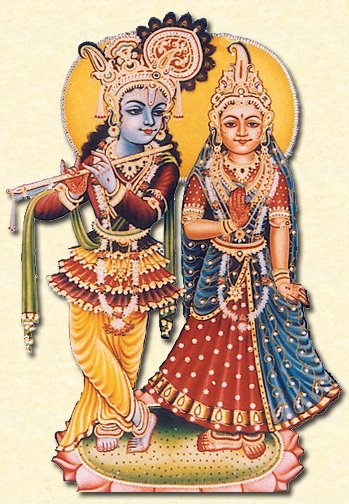
Krishnarati Dasi in North Carolina sent us the following Krishna conscious addition to the Housewives Lament:
One day I was walking
I heard a rejoicing
I saw a happy woman
The picture of bliss.
In her hands were some beads
and these were her words
So fortunately I didn't miss:
"O life was a toil,
And love was a trouble
Beauty did fade and riches did flee
But when Krishna appeared
He burst maya's bubbles
And now everything's sweeter
Than I could wish it to be!"
(Apologies for that not-quite right-rhyming!)
The Housewife's Lament
Mahashakti just sent us this. This material world is definitely not a very nice place.

1. One day I was walking,
I heard a complaining,
I saw a poor woman
The picture of gloom.
She gazed at the mud
On her doorstep ('twas raining),
And this was her song
As she wielded her broom:
/Chorus:
/"O life is a toil,
And love is a trouble,
Beauty will fade
And riches will flee,
Wages will dwindle
And prices will double
And nothing is as I
Would wish it to be."
2. "There's too much of worriment
Goes to a bonnet,
There's too much of ironing
Goes to a shirt.
There's nothing that pays for
The time you waste on it,
There's nothing that lasts us
But trouble and dirt.
/Chorus:/
3. "In March it is mud,
It's slush in December,
The midsummer breezes
Are loaded with dust.
In fall the leaves litter,
In muddy September
The wallpaper rots
And the candlesticks rust.
/Chorus:/
4. "There are worms on the cherries
And slugs on the roses,
And ants in the sugar
And mice in the pies.
The rubbish of spiders
No mortal supposes,
And ravaging roaches
And damaging flies.
/Chorus:/

5. "It's sweeping at six
And i's dusting at seven,
It's victuals at eight
And it's dishes at nine.
It's potting and panning
From ten to eleven.
We scarce break our fast
Till we plan how to dine.
/Chorus:/
6. "With grease and with grime
From corner to centre,
Forever at war
And forever alert.
No rest for a day
Lest the enemy enter,
I spend my whole life
In the struggle with dirt.
/Chorus:/
7. "Last night in my dreams
I was stationed forever,
On a far distant rock
In the midst of the sea.
My one task of life
Was a ceaseless endeavor,
To brush off the waves
As they swept over me.
/Chorus:/
8. "Alas! 'Twas no dream -
Ahead I behold it,
I see I am helpless
My fate to avert!"
She lay down her broom,
Her apron she folded.
She lay down and died
And was buried in dirt.
/Chorus:/
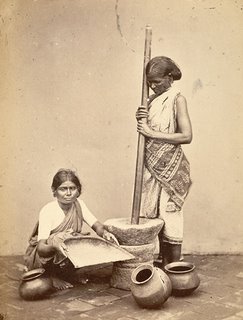 PHOTO CREDITS
Picture one: Advertisement For Jeye's Disinfectants.
From the British Library
Medium; Print on paper
Genre; Leaflet
Printer; Unknown, British
Circa 1870
Picture two: Advertisment for Goddard's Cleaning Materials
From the British Library
Medium; Print on paper
Genre; Leaflet
Printer; Unknown, British
Circa 1800s
Picture three: Women pounding and cleaning rice in Madras
From the British Library
Photographer; Nicholas and Curths
Circa 1870
The Housewife's Lament
by Vera Johnson

1. One day I was walking,
I heard a complaining,
I saw a poor woman
The picture of gloom.
She gazed at the mud
On her doorstep ('twas raining),
And this was her song
As she wielded her broom:
/Chorus:
/"O life is a toil,
And love is a trouble,
Beauty will fade
And riches will flee,
Wages will dwindle
And prices will double
And nothing is as I
Would wish it to be."
2. "There's too much of worriment
Goes to a bonnet,
There's too much of ironing
Goes to a shirt.
There's nothing that pays for
The time you waste on it,
There's nothing that lasts us
But trouble and dirt.
/Chorus:/
3. "In March it is mud,
It's slush in December,
The midsummer breezes
Are loaded with dust.
In fall the leaves litter,
In muddy September
The wallpaper rots
And the candlesticks rust.
/Chorus:/
4. "There are worms on the cherries
And slugs on the roses,
And ants in the sugar
And mice in the pies.
The rubbish of spiders
No mortal supposes,
And ravaging roaches
And damaging flies.
/Chorus:/

5. "It's sweeping at six
And i's dusting at seven,
It's victuals at eight
And it's dishes at nine.
It's potting and panning
From ten to eleven.
We scarce break our fast
Till we plan how to dine.
/Chorus:/
6. "With grease and with grime
From corner to centre,
Forever at war
And forever alert.
No rest for a day
Lest the enemy enter,
I spend my whole life
In the struggle with dirt.
/Chorus:/
7. "Last night in my dreams
I was stationed forever,
On a far distant rock
In the midst of the sea.
My one task of life
Was a ceaseless endeavor,
To brush off the waves
As they swept over me.
/Chorus:/
8. "Alas! 'Twas no dream -
Ahead I behold it,
I see I am helpless
My fate to avert!"
She lay down her broom,
Her apron she folded.
She lay down and died
And was buried in dirt.
/Chorus:/
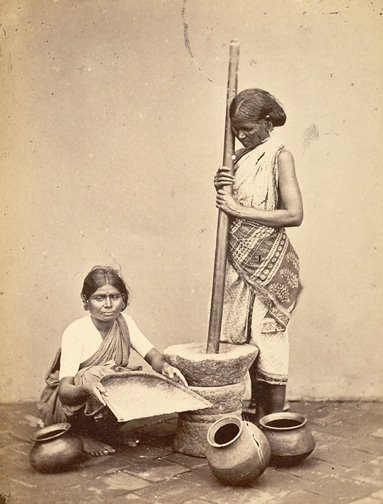 PHOTO CREDITS
Picture one: Advertisement For Jeye's Disinfectants.
From the British Library
Medium; Print on paper
Genre; Leaflet
Printer; Unknown, British
Circa 1870
Picture two: Advertisment for Goddard's Cleaning Materials
From the British Library
Medium; Print on paper
Genre; Leaflet
Printer; Unknown, British
Circa 1800s
Picture three: Women pounding and cleaning rice in Madras
From the British Library
Photographer; Nicholas and Curths
Circa 1870
Thursday, January 12, 2006
The False Sannyasi
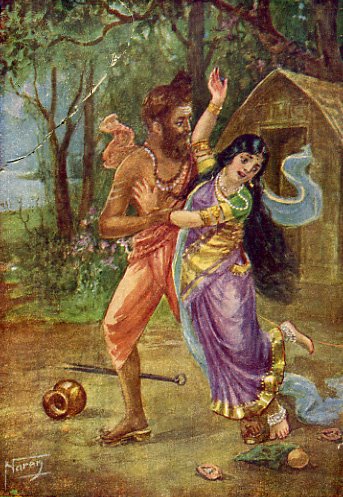
This is an excerpt from Bindu 116. The picture is from an old Bengali version of Ramacarita Manas.
Rev. A. G. Atkins
Mr. A. G. Atkins was a Britisher and a Christian missionary who first came to India sometime before 1916. In order to meet the language study requirements of a missionary he began to read the Hindi version of Ramayana composed by the poet Tulsidas. He quickly became attracted to the story and devotional spirit of the story of Lord Rama and began a careful study of the book that continued for over twenty years. In 1941, on the suggestion of a friend, he began to translate it into English verse. He spent 12 years working on his poetic translation and finally saw the book published by the Hindustan Times in June of 1953. The following is an excerpt from book III, chapter 13.
Now, when Ravan saw that his way had been cleared,
He in hermit’s guise there before Sita appeared;
He who kept gods and demons in such total fright,
That they ate not by day and could not sleep at night,
Himself now afraid, like a dog that is seeking
To steal, looking all ways, came furtively sneaking;
His feet set in evil ways, counting no cost,
Ev’ry trace of strength, wisdom and glory now lost,
He told stories to Sita of customs and laws,
Giving kindly ways, threat'nings and love as his cause;
She replied, “Tho’ in guise of the saintly you speak,
“Full of evil and wrong are the things that you seek.”
Then his true name and form demon Ravan displayed;
Sita, seeing and hearing, was deathly afraid;
She replied, as she rallied her courage and will,
“Wretch! My husband is coming! Stand off and stand still!
“You are doomed, demon ruler; you’re now well-nigh dead,
“Like a rabbit that would with a lioness wed.”
At these words shame and wrath moved him more than before,
At heart feeling, “Here’s one to enjoy and adore!”
Then he seized Sita roughly and angrily, and in
His chariot waiting there placed her;
Altho’ from his trembling he scarcely could drive,
Thro’ the air to his dwelling he raced her. ·
— Pages 885-6. The Ramayana of Tulsidas. Published by Shri Krishna Janmasthan Seva-sansthan. Mathura, India. 1987.
Tuesday, January 10, 2006
Jaya Gopal!
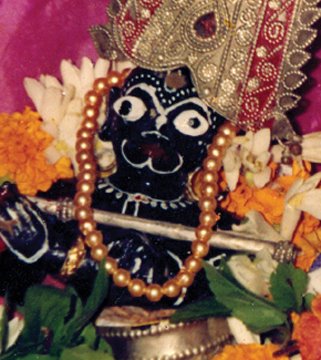 kasturI-tilakaM lalATa-paTale vakSaH-sthale kaustubham
nAsAgre vara-mauktikaM kara-tale veNuH kare kaGkaNam
sarvAGge hari-candanaM su-lalitaM kaNThe ca muktAvalI
gopa-strI-pariveSTito vijayate gopAla-cUDA-maNiH
All glories to the crest jewel of cowherd boys known as Gopal, who has a musk tilaka-mark on his forehead, the kaustubha jewel on his chest, a graceful pearl on the tip of his nose, a flute in His hand, a bracelet on his wrist, graceful sandalwood paste on all of his limbs, a necklace of pearls on his neck, and who is surrounded by a host of gopis.
-- Sri-gopal-sahasra-nama, text 28
Friday, January 06, 2006
Thursday, January 05, 2006
Tuesday, January 03, 2006
Gopaljiu Parikramas
 Our new blog site. We are just starting but I've posted a few things. We intend to update this site with pics and explanations of our research on different tirthas and places in India. Check it out:
http://gopaljiuparikramas.blogspot.com/
Monday, January 02, 2006
A few photos from our ashram
 Left side: Seshadevaji, who cooks, manages our book stock and plays ecstatic mrdanga in our bhajans and kirtans. Right side: Pradoshji, who manages our Indian book sales, translates and helps with research. Center: Madhavananda Das who eats and sleeps a lot.
 Here is Pradoshji standing next to some of our books and the cabinet of Guru Maharaja's lecture tapes. We have nearly 3,000 tapes.
Sunday, January 01, 2006
Ramananda Ray's Pen

This is the original (more than 500 years old) pen of Mahaprabhu's associate, Srila Ramananda Ray. We took the photo in his ancestral home near Jagannath Puri. It’s not an ink pen -- this is what they used for writing on palm leaves.
Serving Guests
One of my greatest sources of happiness is serving guests who come to our Gopaljiu Publications ashram. Over the years many sadhus, sannyasis, scholars and illustrious personalities have come to visit us and our library. We try to feed them as best we can, pick them up from the airport or train station, help them make arrangements with their travel tickets, take them on parikrama, find rare books for them etc, etc, etc. The atithi is our great friend and worshipable guru. Sastra says:
gurur-agnir-dvijAtInAM varNAnAM brAhmaNo guruH
patireva guruH strINAM sarvasyAbhyAgato guru
abhyAgataM pathi ZrAntaM sAvajJaM yo ‘bhivIkSate
The guest and the critic are the two real kinsmen of the entire universe. The critic dispels sins and the guest bestows heaven. -- Brahma Purana 163.20
There is much that could be said about these two verses. Unfortunately, I have a heavy deadline if we are going to make out next mag on time (it looks like me might not even make it). Later, if there is time I’ll try to write something. As far as the critic dispelling sin, we compiled a number of verses on that topic which we published in an article in Bindu no. 92.
Below are a few photos of some of the guests who have kindly graced us with their association.
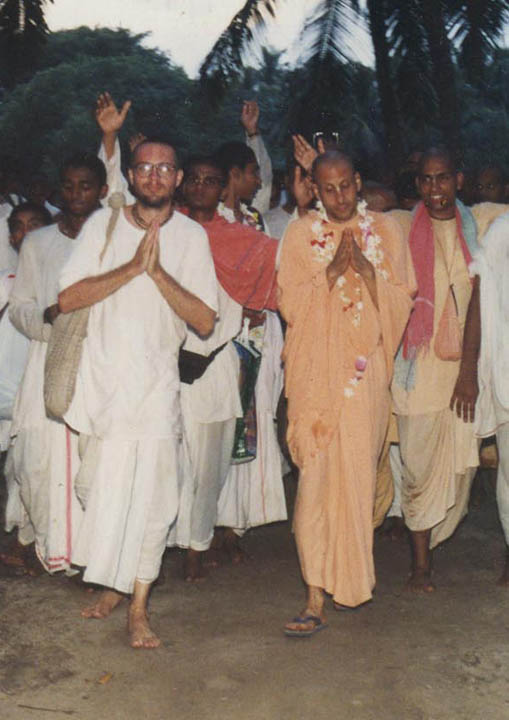
Madhavananda Das on the left front with HH Radhanath Swami and his followers in Brahmagiri Orissa. In this shot we are just walking away from the chandan pukur, that Srila Saraswati Thakur said was non-different from Radha Kund.

Yasodananda Das Babaji is a learned scholar and mahunt in an ashram in Athagarh Orissa, where our Guru Maharaja once taught school. He sometimes comes to bless us with his sanga.

HH Rasananda Swami visits our ashram. Left to right: Bhaktarupa Prabhu, HH Rasananda Swami who preaches in Brazil, Madhavananda Das and Bhakta Pradosh

This is Srila Prabhupada's disciple Pradyumna Prabhu. He stayed with us for a few days. Pradyumna was Srila Prabhupada's Sanskrit editor. Prabhupada used to call him "panditji".
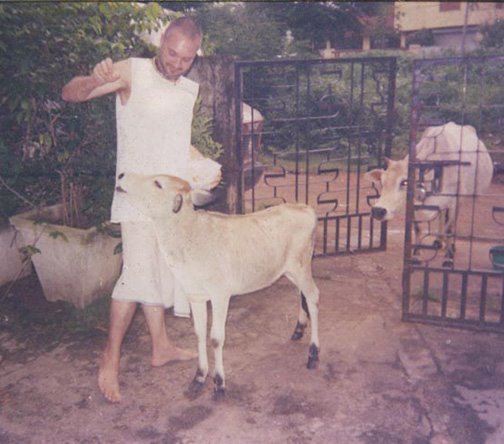
This is Radha the calf and her mother in the background. She came to our ashram everyday (several times a day) for many months to get goodies. She is very fond of capatis with ghur.
Nandagram at Sunset
 Bhurijan Prabhu just sent us this wonderful picture along with the following text:
Srila Narottam Das Thakur prays in in Prema Bhakti Candrika as follows:
gobinda gokulacandra parama ananda-kanda
paribara-gopa-gopi sange
nandiswara jara dhama giridhari janra nama
sakhi-sange tare bhaja range
paribara-gopa-gopi sange
nandiswara jara dhama giridhari janra nama
sakhi-sange tare bhaja range
Sri Govinda, the moonlike personality of Gokula, the lifter of Govardhana Hill, the reservoir of all transcendental happiness is accompanied by the gopalas and the gopis and is living in Nandagram. Serve Him happily in association with the sakhis.
Saturday, December 31, 2005
Jaya Sri Radhey!
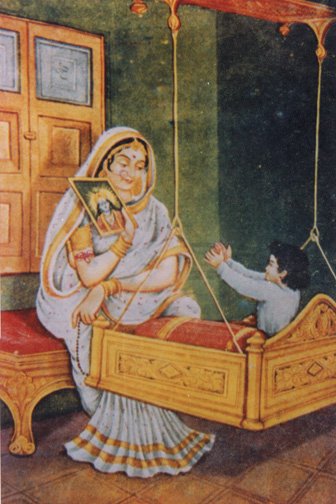 Mother Kirtida shows baby Radha a picture of Krishna
The Appearance of
Srimati Radharani
Sri Srimad Gour Govinda Swami Maharaja
The Brahma-vaivarta Purana describes that once, in the transcendental abode of Vrindavan, Krishnachandra was sitting on a golden throne under a madhavi creeper. He was thinking of how to further relish the nectarean mellows of his pastimes. Due to this thought, by his mere will, Srimati Radharani appeared from the left side of his body. Radharani’s form was the color of molten gold and was decorated with various ornaments. On her braid was a flower bouquet; on her breast a garland of pearls (mukta mala); and around her waist hung an ornamented belt (mekhala). Beautiful golden earrings adorned her ears, and the anklets (nupura) on her feet produced a tinkling sound.
In the Padma Purana, uttara-khanda, Shivaji told Parvati about the appearance of Radha: “Vrishabhanu Maharaja was a great devotee of the Lord. His chaste and devoted wife was named Kirtida. It is from her womb that jagan-mata, the mother of the whole world, Sri Radha, took birth. This auspicious appearance of Brajeswari occurred at

Sri Sri Radha Gopaljiu in Gadeigiri
“One day, Narada Muni came to the quarters of King Vrishabhanu to have darsana of Radharani. The sage inquired about his and the kingdom’s welfare. In a humble mood, the king replied, ‘Because of your mercy, everything is auspicious. You are such a great sadhu. Wherever you go becomes a tirtha. By your grace, everyone can get hari-bhakti.’
“Saying this, Vrishabhanu Maharaja placed his daughter, whose eyes were still closed, on the lap of Narada Muni. By the touch of Radharani, the sage became ecstatic, the hairs on his body stood on end, and tears like torrential rain flowed from his eyes. In his heart, Narada Muni began to offer prayers to the little girl.
“’You are hari-priya, dear to Lord Hari; mahabhava-svarupa, the personification of the highest love; govinda-mohini, the enchanter of Govinda; krsna-prana-rupa, the life and soul of Krishna; ananda-svarupa, the very embodiment of bliss. You are bhakti and tapa. All of the demigods headed by Brahma and Shiva meditate on your lotus feet. All of
“Hearing the prayers of Narada Muni, Radharani mercifully showed her form to him. The muni beheld a vision of Radhika seated upon a throne studded with divine gems, under the shade of a wish-fulfilling tree. Innumerable sakhis, some fanning her, some waving camaras, and others holding a white umbrella over her head, surrounded her. Brajeswari’s body was covered with beautiful transcendental garments. Her forehead was decorated with designs drawn with sindhura and a glow emanated from her body. By her mercy, Radharani revealed this beautiful form to Narada Muni, and he alone could see it.
“All the while, Radhika, in the form of a baby, was lying on the lap of Narada Muni. Narada Muni returned the child to her father, seated with his queen before the great rsi. The sage said, ‘You are most fortunate, maha-bhagyavan, because you have such a wonderful daughter. Kamala, Parvati, Arundhati, Sachi, Satyabhama — are all just plenary portions or portions of plenary portions of Radharani. No one is as dear to Lord Hari as she. Because of your daughter, all of Gokul will be filled with opulence. Do not feel sorry that you have a girl. Because of her, your glory will spread far and wide.’
 Srila Gour Govinda Swami's
palm leaf Oriya Bhagavatam
“With folded hands, King Vrishabhanu asked, ‘Who will be her husband?’ The great sage replied, ‘She will be the wife of the supreme purusa. And in the course of time her eyes will open.’ Saying this, Narada Muni left.”
After hearing this account, Parvati inquired of Shivaji, “Why were Radharani’s eyes not open?”
Shivaji said: “O Devi, this is another wonderful story. When Lord Hari wanted to descend to this material world, he called Radha and said, ‘You, too, will take birth there with me. We will manifest wonderful lilas together.’
“Then Radha said, ‘O my dear lotus-eyed Hari, if I take birth in the material world I will be so distressed. How can I bear to see other men? I only want to see you. I refuse to look upon the form of another.’
“
 Srila Prabhupada and disciples walk in Mayapur
Srila Gour Govinda Swami is just behind Prabhupada
“Lord Hari took birth as the son of Nanda Maharaja in order to protect the sadhus – sadhu raksa kare. Radha took birth from the womb of Kirtida as the daughter of Vrishabhanu.
“Because of the birth of the divine couple, the whole universe became exuberant. But Radha’s eyes were not open. Seeing this, Kirtida Maharani was alarmed.”
Parvati then inquired, “Please tell me how Radharani opened her eyes.”
Shivaji said, “I will tell you. Simply by hearing this account one receives transcendental happiness.
“King Vrishabhanu held a great festival on the auspicious occasion of his daughter’s birth. He invited all the cowherd men and women, extending a special invitation to Nanda Maharaja and Yashodarani. Nanda Maharaja and his wife arrived at the
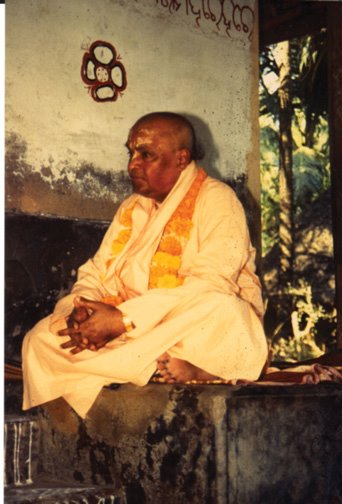
Srila Gour Govinda Swami at
Gopal's temple in Gadeigiri Orissa
Gopal's temple in Gadeigiri Orissa
“Maharaja Vrishabhanu welcomed Nanda Maharaja, embracing him. Kirtida welcomed Yasoda-mata, embracing her.
“The magnificent festival continued; all different kinds of instruments were played — kettle-drums, bugles, violins, vina, etc. Meanwhile, in the inner quarters of the palace, Sri Radha was sleeping in her cradle. Lord Hari, who is the antaryami, supersoul in the hearts of all living entities knew this.
“Unnoticed by anyone, baby
“At that time, Kirtida came there and saw what had happened. Taking the baby girl onto her lap, she happily exclaimed, ‘
This is the inconceivable lila of
Srimati radharani ki jaya!
Kana-mana-mohini radharani ki jaya!
Vrndavana-vilasini radharani ki jaya!
Asta-sakhi-siromani radharani ki jaya!
Vrsabhanu nandini srimati radharani ki jaya!
Ethics and Devotion (Long article)
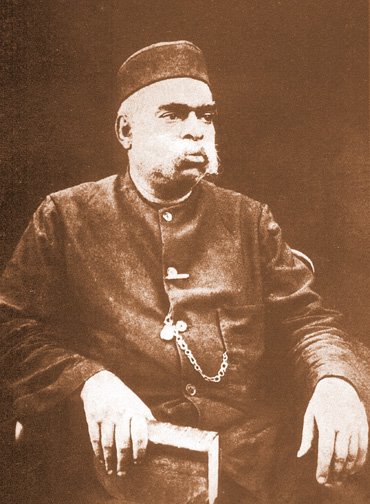 Srila Thakur Bhaktivinode
in his magistrate dress
Ethics & Devotion
By Madhavananda Das
Below is a lecture we gave about the teachings of Srila Thakur Bhaktivinode (pictured above) before The National Seminar on Values and Ethics in Business, Utkal University, Bhubaneswar, Orissa, India, on April 20, 2000. It later appeared (in the below edited form) in the May/June 2001 issue of Back To Godhead magazine
BEFORE COMING here today I was considering how it is that a group of professors and professional businessmen would invite a shaven-headed renunciant dressed in simple dhoti and kurta, with no money of his own and no business experience, to be the chairman of the first session of this seminar. Why would you spend your valuable time unless there was some practical and profitable reason? You must be considering that the spiritual conception of ethics has practical value in today’s business world. Here we’ll discuss the spiritual conception of ethics from a most practical perspective, as presented by the famous son of Orissa Srila Bhaktivinode Thakur.
Bhaktivinode Thakur (1838–1914) was the great theologian who first presented the teachings of Chaitanya Mahaprabhu in a modern context. His pioneering efforts have manifested today as the Hare Krishna movement, which is being spread worldwide by ISKCON, or the International Society for Krishna Consciousness. In a discussion on ethics it is significant to analyze the work of ISKCON. The cultural and philosophical teachings of ISKCON have inspired millions of people all over the world to reject immoral behavior and embrace a saintly way of life.
Ethical Systems
The term ethics refers to the systems of moral behavior accepted by individuals or groups. Different mature individuals will have different conceptions of what kinds of behavior are right and what kinds are wrong. Such conceptions of right and wrong define different ethical systems. As leaders of society we need to know which ethical systems are valuable in a progressive society and which are not, and those which are valuable should be promoted. Bhaktivinode Thakur has offered a scientific conception of ethics and morality based on the Vedic literature, which states that a truly progressive society is one that discourages its members from exploiting others.
Societies that adopt ethical systems based on materialistic conceptions cannot be progressive because they cannot be free of exploitation. To establish this, Bhaktivinode has described four categories of materialists:
(1) Those who have no ethics and no faith in God: immoral materialists.
(2) Those with ethics but no faith in God: non-theistic moralists.
(3) Those with ethics based on faith in God, but who give more importance to morality than they do to God: theistic moralists.
(4) Those who engage in immoral behavior while posing as theists: pretenders.
Immoral Materialists
Those who follow no ethical system are the lowest of human beings. They are the primitive peoples and the hedonistic modern man. Indeed, such human beings are on the same level as animals. Bhaktivinode describes the attitude of the hedonists: “They consider that this variegated universe is simply a chance combination of atoms and molecules with no creator. Any belief in God or the soul is simply blind faith and gross superstition. As we only live once, a person should try to enjoy as much as possible.”
With his far-seeing vision, Bhaktivinode Thakur perfectly described the popular idea embraced by many today that life is simply a chance combination of chemicals with no intrinsic purpose. With such a conception there is no particular need to honor or respect others. Is it any wonder that a great ethical crisis has risen and sprouted into an increase of violent crimes and corruption?
Non-Theistic Materialists
Next, Bhaktivinode describes that higher than the immoral materialists are the non-theistic moralists who accept some ethical system but are not concerned with God. Describing the view of the non-theistic moralists, he has written:
Being more intelligent, the moralist can easily defeat the immoral materialist. He says: “Oh brother, I respect what you say but I cannot accept your self-motivated actions. They are not at all good. You are seeking out happiness in life, but without morals how can there be happiness? Do not think that your life is everything! Consider society as well. Rules which can increase the happiness of the human being in society are advisable. That is called morality. Gaining happiness through morality makes man superior to animals. It is necessary for man to accept individual suffering where it will give happiness to society. That is called selfless morality, and it is the only path for man. You must cultivate all the positive sentiments such as love, friendship and compassion in order to increase the over-all happiness of society. By doing this, violence, hatred and other evil tendencies will not be able to contaminate the heart. Universal love is universal happiness. Take up ways of increasing this happiness.” Positivists such as Compte and Mill, Socialists such as Herbert Spencer, as well as lay Buddhists and Atheists firmly believe this philosophy.
The non-theistic moralists are superior to the immoral materialists, but they are still selfishly motivated. Although they follow the ethical and moral rules of society, they do so to avoid public censure, imprisonment, or execution. A businessman may adopt ethical principles just to ensure plentiful customers, or a politician may accept ethical principles to attract followers. This is a more intelligent position than that of the immoral materialist, as there is concern for long-term enjoyment rather than just immediate gratification. However, since there is still an underlying selfishness, a non-theistic moralist is likely to exploit others as soon as he or she thinks there will be no adverse reaction.
Included in this category are the mundane philanthropists who engage in work for the physical, mental, or emotional well-being of others. Because they are unable to appreciate the objects of their compassion as anything more than dull chemicals, the “good deeds” of such “selfless” moral materialists are invariably motivated for their own enjoyment, either subtle or gross. In actuality their “selflessness” is only a facade, for their actions are motivated by the desire to have the satisfaction of thinking of themselves as, or being well known as, greatly pious persons.
The Scorpion And The Camel
The ethics of the non-theistic moralists are compared to those of the scorpion who once requested a favor from a camel. The scorpion wanted to cross a deep river but could not find any way to do so. Seeing a camel nearby, the scorpion approached him and asked the camel to carry him across. The camel refused, saying, “You will sting me.”
“No, no. I am an ethical scorpion. I promise I won’t sting you.”
The camel agreed and, taking the scorpion on his hump, began crossing the river. Halfway across, the scorpion suddenly stung the camel.
“Why did you do that?” the camel asked. “Now we will both die.”
“What can I say?” the scorpion replied. “It’s my nature.”
Similarly, although the non-theistic moralists try to live an ethical life, because their concept of the meaning of life is limited to dull matter any ethical behavior they adopt is selfishly motivated and quickly discarded.
Although they speak about universal love and brotherhood, the non-theistic moralists, like their immoral brothers, are unable to appreciate others as anything more than dull matter. Their perception is limited to the external body, and the relationships they form with others are similarly skin-deep — shallow, short-lived, and ultimately prone towards exploitation. Since they identify themselves as temporary matter, there is no reason for them to perform truly selfless acts. The best social message the non-theistic moralists can offer is, “You are just a bag of chemicals and molecules that somehow just appeared and has no intrinsic meaning. Other persons are also only bags of chemicals and molecules—but you should be nice to them.”
The natural reply will be, “Why should I be nice?”
“Because it’s the good thing to do, and if you don’t you’ll go to jail.”
Since the basic motivation of the ethical behavior of atheists is to avoid public censure, is it any surprise that as soon as they think they have an opportunity to gain some illicit advantage without getting caught they will do so?
Theism
More fixed in ethical conduct and hence superior to the non-theistic moralist is the theist. The theist is dissatisfied with the mechanistic concept of life offered by the non-theist. Bhaktivinode describes the thinking of the theist as follows:
If consciousness arises by some special process through combination of atoms, there should be some evidence of this somewhere in the universe. There should be some example of this in human history. Man is produced from the womb of a mother. Nowhere is any other process observed. In spite of the growth of material science, nothing otherwise has yet been observed. Someone may argue that man has arisen by a chance combination of matter, and later man has adopted this particular process of birth from the womb. However, the succeeding events should be similar to the first event. Even now we should observe at least a few conscious entities arising by chance combination of matter. Therefore it can only be logically concluded that the first mother and father must have arisen from the supreme consciousness.
When the materialist becomes dissatisfied with the mechanistic idea that consciousness is simply a chance combination of chemicals, and thereby concludes that life must be something anti-material or spiritual, he comes to the platform of theism.
Bhaktivinode points out many ways in which belief in God contributes to moral conduct:
(1) Even is someone has a strong sense of moral values, still the senses are often so strong that even great moralists are defeated. If the opportunity arises to enjoy immorally in secret, belief in God will act as a preventative measure. God can see what man cannot. One who thinks like that will be unable to secretly perform acts contrary to morality.
(2) Everyone will accept that faith in God produces a greater tendency to perform pious acts than morality alone.
(3) If God exists, then by faith in Him so much is gained. If He does not exist, believing in Him is harmless. On the other hand, if God does exist, to not have faith in Him is harmful.
(4) By belief in God, the tendency toward righteousness grows quickly in the mind.
(5) By faith in God, compassion and tolerance become stronger.
(6) By belief in God, one is more eager to perform selfless action.
(7) By belief in God, acceptance of afterlife arises, and man cannot be disappointed by any event in life.
Morality More Important
Bhaktivinode states that among the theists, most are materialistic. He describes a group called the theistic moralists who worship God with some degree of faith, but who give more importance to their conception of morality than they do to God. Some of them believe there is no harm in imagining a God, worshiping him with faith, and then abandoning that worship when good conduct is achieved. Others believe that by performing worship of the Lord and acting ethically, the Lord will be pleased and will grant one’s material desires.
Either subtly or grossly, the worship of the theistic moralists is selfishly motivated. Although they consider themselves worshipers of God, they are not much interested in God’s form, personality, activities, or desires, but instead are interested only in what they can gain through worshiping Him.
Bhaktivinode compares the relationship between the theistic moralists and God to the temporary meeting of travelers at an inn. When morning comes and the travelers leave for their separate destinations, the relationship is forgotten. Theistic moralists worship the Lord not out of devotion but simply because they think it to be the proper thing to do, which will result in their happiness.
Being motivated in this way, materialistic theistic moralists are still in the realm of selfishness. Although they conceive of their ethical behavior as being harmless to others, because they are not on the platform of spiritual vision they are unable to maintain impartial dealings and will inevitably fall prey to exploiting others.
In describing different types of activities aimed at human welfare, Bhaktivinode has stated in his Sajjana Toshani magazine: “Showing kindness to the soul is the best welfare work of all. By such kindness one attempts to save a person from all worldly sufferings by giving him devotion to Lord Krishna.”
Because the theistic moralists are not functioning on the spiritual platform, their ethical systems will never be able to alleviate all the worldly sufferings of the living entities; hence they are unable to completely serve society. They will always fall prey to narrow biases based on bodily, social, or religious differences. In actuality, their relationship with others is much like their relationship with God: as superficial as travelers meeting at an inn.
Although there is some partial social benefit from the ethics of the theistic moralists, because there is no spiritual bliss in the mechanical worship they perform there is every chance that they will either give up their theism or else adopt the ways of the cheating pretender.
Pretenders
The next class are those who engage in immoral behavior while posing as theists. Bhaktivinode has described them as pretenders. He says:
Although the pretenders do not accept the eternal nature of devotion, they wear the dress and markings of a believer. They have their own motives, which any honest person would decry. Cheating everyone, they pave the way for a world of sin. Undiscerning people, allured by their external appearance, take up the same path and end up rejecting God. They may have beautiful tilaka, devotional dress, chant the name of
Bhaktivinode has compared such pretenders to the cat and the crane. Once some mice came and said, “Have you heard the news? The cat has become a saint. He is now wearing tilaka and neck beads. He is chanting and has become a vegetarian.” Thinking in this way, the mice gave up their fear of the cat. But when the mice started to come nearby, the cat gave up his pretense and pounced on them.
Similarly, the crane stands motionless on one foot for hours at a time, and thus looks like a great yogi. His real motivation, though, is to catch fish. As soon as a fish comes near, he abandons his saintly demeanor and gobbles it up.
Bhaktivinode has said, “There is no worse association in the world than such pretenders. It is better to associate with immoral atheists than to associate with them. … Only if one gives up the association of crooked hypocrites can he honestly engage in devotional service. Honest worship is the only way to attain
By presenting themselves as saintly and concerned for others, the pretenders sometimes gain positions of trust and responsibility in even spiritually-minded societies. But because their real motivation is to exploit others to satisfy their own subtle or gross pleasures, they are the worst enemies of society.
The Devotees
Devotees who are situated on the platform of pure love of God see their beloved Lord everywhere and see everything, moving and non-moving, in connection with God. From such a platform, to offer respect to all living entities regardless of material bodily designations is quite natural and genuine, and thus on this platform alone can one be free from the propensity to exploit others.
The Bhagavata Purana explains that even though one may follow religious ethics for some time, without genuine devotion to the Lord the subtle desires in the heart, which are the roots of immoral tendencies, are not destroyed and will rise again. Only pure devotion can remove all immoral tendencies. This is described in the Bhagavata:
kecit kevalayA bhaktyA vAsudeva-parAyaNAH aghaM dhunvanti kArtsnyena nIhAram iva bhAskaraH
“Only a rare person who has adopted complete, unalloyed devotional service to the Supreme Lord Vasudeva,
Moral Behavior?
One problem arises in our discussion of morality. Sometimes, understanding the moral behavior of devotees is difficult. A good example is the activities of
Any activities that are spiritual are all-good, and any activities that are material are all-bad. This is the difference between spiritual and material. The so-called morality and goodness of the material world is bad, but in the spiritual world even so-called immorality is good. This we must understand. For example, to dance with the wives of others at the dead of night is immoral, at least according to the Vedic civilization. Even today in
The gopis superficially seem to transgress the codes of mundane morality. This perpetually puzzles mundane moralists. … The reason the Lord displays the rasa-lila is essentially to induce all the fallen souls to give up their diseased morality and religiosity, and to attract them to the
Our standard of morality and immorality is to see whether
Conclusion
According to Bhaktivinode, the best ethical system is that which is based on the awareness that all others are part of the Supreme Lord and meant to give pleasure to Him alone. Any system that gives prominence to the fulfillment of one’s own selfish desires will ultimately be exploitative and thus harmful to the progress of society.
These are some of the practical teachings of Bhaktivinode Thakur on the topic of ethics. I hope that the respected and learned persons of this assembly will consider them deeply.
Subscribe to:
Posts (Atom)